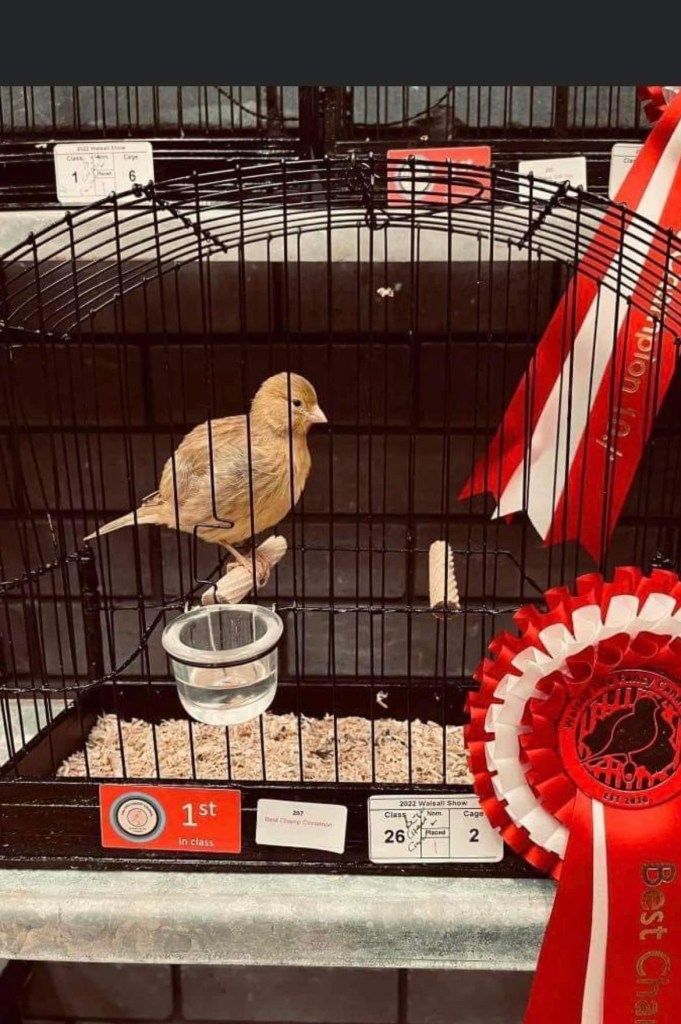
The Cinnamon Factor
Many fanciers struggle to understand the concept when using Cinnamon’s in the breeding program, I will try to explain this in simple terms. The Cinnamon gene is a sex – linked recessive gene that means the Cinnamon colour is passed on by the X chromosome. ( For the purpose of this article a normal coloured bird is any bird from a clear yellow through to a self green, a clear white through to a self blue, yellow or buff feathering making no difference).
A cock bird has two X chromosomes, either one or both chromosomes could be affected. If one chromosomes is affected the cock will be a normal coloured bird carrying the Cinnamon gene. If both chromosomes are affected the cock will be a visual Cinnamon. This tells us a cock bird can be one of three types, a normal coloured bird, a normal coloured bird carrying Cinnamon, or a visual Cinnamon. The hen on the other hand has only one chromosome the other being Y, this means a hen can only be one of two types, a normal coloured bird, or a visual Cinnamon, a hen cannot pass on the Cinnamon factor unless it is a visual Cinnamon. The following table will give you an idea what to expect from the possible pairings.
Parents Offspring
1) Normal Cock/Normal Hen ……………………… All Normal
2) Normal Cock/Cinnamon Hen ……………………. All Norma but Cocks will be Carrying Cinn
3) Cinnamon Cock/Normal Hen …………………….. 50% Normal cocks carrying Cinnamon,
50% Cinnamon Hens
(All visual Cinnamons from this mating will be hens)
4) Normal Cock carrying Cinnamon/Normal Hen …. 25% Normal Cocks,
25% Normal Cocks carrying Cinnamon,
25% Normal Hens,
25% Cinnamon Hens
5) Normal Cocks carrying Cinnamon/Cinnamon Hen 25% Normal Cocks carrying Cinnamon,
25% Cinnamon Cocks,
25% Normal Hens,
25% Cinnamon Hens
6) Cinnamon Cock/Cinnamon Hen ………………….. All Cinnamon
The number four pairing is not a very good pairing. This pairing will produce all normal coloured cocks some carrying Cinnamon and some not. The only way to tell if a cock from this pairing is carrying Cinnamon is to test mate the bird in the following season, although this will not prove anything if there are no visual Cinnamons produced, because if you look at the prospective offspring from such a pairing, there is only a 25% chance of producing a Cinnamon hen and that is the only way to confirm the cock is a Cinnamon carrier, although the cock could still have produced Cinnamon carrying cocks.
If you carry on regardless using normal coloured cocks birds from such pairings you may end up with Cinnamon right through you breeding stock. To be on the safe side treat all the cocks from such pairings as Cinnamon carriers.
The other possible variation in colour is fawn’s the way to achieve this is to introduce a white ground bird to a Cinnamon. A white ground bird is any bird from a clear white through to a self blue. The possible variations are, a visual Cinnamon cock to a white ground hen, or a Cinnamon carrier cock to a white ground hen will produce the odd fawn hen, or the best possible mating of a white ground Cinnamon carrier cock to a Cinnamon hen this will produce fawn cocks and hens, a fawn can be used in the above mating’s instead of the Cinnamon. Where two possibilities exist, the theoretical expectation is 50% of each, but in practice this is not always the case.
Mr Jim Watkins. ( West Wales)
 Down the Shed