Breeding Bullfinches by Sean Fitzpatrick
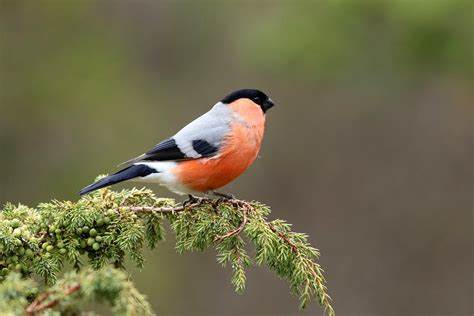
Breeding Bullfinch by Sean Fitzpatrick Many old wives tales have deterred people from attempting to keep Bullfinches. Most, if not all, of these tales are fictitious and are often spread by people with little or no long term experience with this fascinating species of bird. Listed here is the successful, annual, month-by-month management regime that I have formulated over my many years experience with the most handsome example of the British finch family.
JANUARY/FEBRUARY:
Following Christmas festivities and the on-set of the new-year, bird-room management is generally simple. The mainstay of the diet is dry seed (Versele-Laga/ Blattner) Bullfinch mix. Orlux Native Finch egg-food, moistened with grated carrot or broccoli, is provided to the birds once a week as a tit-bit. In addition, a few dried rowan- berries are added to the seed 2/3 times a week. Vitamins are given through the water every day of the year in the form of Aviform Ultimate for pigeons. Products designed for use in pigeons are in my opinion, superior to those formulated for cage-birds as they are researched more than the latter.
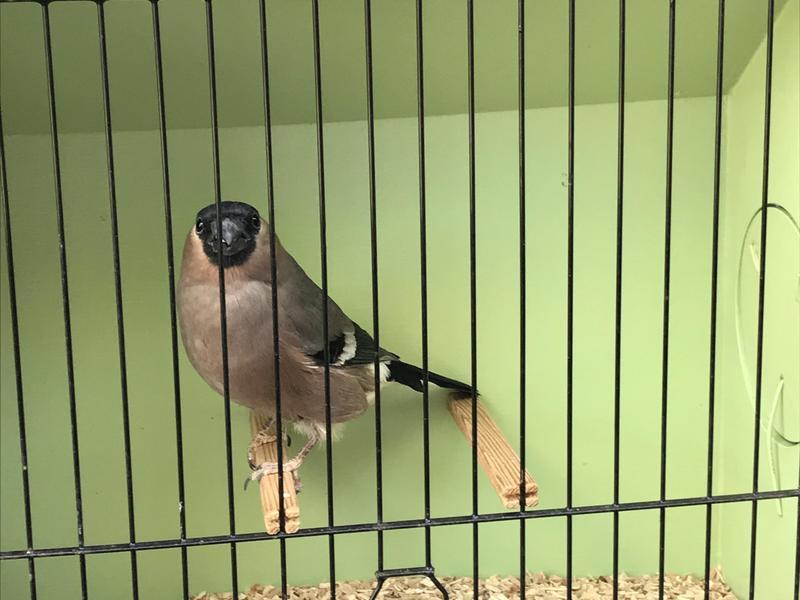
At this, the coldest part of the year I withdraw bathing facilities from the cages, preferring to give the birds a fine spray from an atomiser. This is to prevent dampness in the bird-room. A de-humidifier is also employed for this reason as Bullfinches have a low tolerance to damp conditions while in contrast; dry cold does not have any adverse affect on them if they are well fed. In aviaries, unless closed drinkers are employed, birds will obviously make their own choice to bath or not, but in aviaries the air is not stagnant so the damp is dispersed. If the birds are over-wintered in cages, a floor litter of beech-wood chippings is my choice when cleaning the cages out once every week or so. These beech chippings are available from many pet supply outlets. This time of year is ideal for introducing prospective pairs, as Bullfinches form a very strong pair bond. Pairing the birds early allows them to settle as a bonded pair before the breeding season.

MARCH: The provision of egg-food is increased to twice a week and at the same time, grated boiled/scrambled egg is added to the mix, making sure that the mix too moist. The introduction of grated boiled egg helps to increase the birds protein intake and this in turn will promote the birds transition into breeding condition. Egg-food should be of a crumbly consistency if souring is to be avoided. This is the month I start to feed petite-pois frozen peas that have been defrosted in hot water. These peas contain all the nutritional requirements that Bullfinches would get from wild vegetable matter. A handful per pair is a rough guide to the amount used. During the second week of March is when I introduce the caged pairs into their chosen aviaries. Some birds kept outside all winter are moved to cleaned and disinfected aviaries. Dry litter is spread onto the aviary floor; this can be hay, straw or something similar. Nest sites are provided at various points of the aviary to provide the birds with a choice when nesting. These sites are of various design with wicker baskets or roofed boxes with felted canary pans being the most usual. When providing cover for the nest sites, artificial plants are employed in preference to real plants as they do not degenerate and go brown and brittle during the nesting period. They are also more pleasing to the eye than dry twigs or branches. Only provide sufficient cover to camouflage the nest sites and perhaps a couple of roosting sites. I have used this method for years after realising that placing too much cover in the aviaries was resulting in shy nervous fledglings. Birds will choose to hide from sight if they are allowed, so by reducing the amount of cover in the aviaries you will eventually get birds that are more confident and will allow you to observe them to the point where they become oblivious to their keepers presence. Perches take the form of various diameter dowel and fruit tree branches. Try to avoid positioning perches over the top of others or above the feed stations and nest sites. This prevents unwanted soiling by the birds’ droppings. To facilitate the easy cleaning of feeding utensils and at the same time avoid stale food being allowed to spill onto the aviary floor,
I use large plastic cat litter trays as feeding stations holding the various pots of feed. This means that feed pots can be replaced with clean ones simply by removing the cat litter tray and replacing it with a tray containing the clean pots. This helps to keep disturbance to a minimum during the nesting period as it is obviously much quicker than handling individual pots.

APRIL:
I start soaking the Blattner mix before feeding to the birds. This alters and improves the nutritional values of the seeds and further promotes breeding condition. The seed should be soaked over night and very well rinsed before giving to the birds. Alternatively, after soaking, the seed can be sprouted by placing it somewhere warm and dark over night. Increase the provision of egg-food to every other day; this will increase the levels of protein in the diet, which in turn heightens their breeding instincts. Petite-pois can be fed ad-lib.
Nesting material placed at various points in the aviaries will have a therapeutic effect on the birds. Bullfinches use coconut fibre, fine roots and hessian string for lining the nest. Some Bullfinches will ignore artificial nest sites and insist on building their own nest,
in the event it will be necessary to collect thin pliable twigs or roots for the birds to build the nest base. Egg laying will follow nest building during the latter part of this month. The usual clutch is five eggs but instances of Bullfinches laying seven or even eight eggs are not uncommon.
MAY / JUNE/ JULY:
During the thirteen-day incubation period, egg-food should be rationed. Feeding egg-food every day at this time would be too rich for the incubating hens so feed a little every second day.
On the twelfth day of incubation, place a few mini-mealworms in the egg-food receptacle. This will introduce the parent birds to live-food in preparation for feeding the chicks. Most Bullfinches are not at all interested in live-food outside of the breeding/rearing period so there is little to gain by introducing live-food any earlier. While some hens will rear their offspring on large quantities of live-food, others will ignore it and choose soak-seed / egg-food in preference to mealworms etc. Contrary to popular belief, this is not detrimental to the well being of the chicks and they will thrive just the same. In any event, the live-food should be withdrawn gradually from the tenth day of rearing onward until it is absent from the diet by the third week. Experience has shown that if too much live-food is available to the birds beyond the second week, fledgling Bullfinches will suffer problems with their liver. The symptoms of this problem include lethargy, immobility and on inspection of the birds abdomen the liver appears as a dark purple patch distended under the rib cage. Following the appearance of these symptoms the majority of birds affected will die. I eventually discovered that staggered rationing of live-food greatly reduces the occurrence of this problem.
Half eggshells on the floor of the aviary are the obvious sign of a successful hatching. Counting the shells can provide you with an idea of how many chicks there are in the nest (some hens will eat the egg shells). Hatching normally occurs on the thirteenth day of incubation. Egg-food is once again fed to the birds every day.
The age-old problem of ring rejection is avoided if attempts to ring the youngsters are delayed until the seventh day. The common advice is to ring chicks at five days of age and this is the problem. At the age of five days, the chicks are too small and the hen is still cleaning the bottom of the nest. At seven days, the chicks are defecating over the edge of the nest and with their eyes open they are able to see the hen coming to feed them. This means that the chicks are raising their heads for food before the hen is able to inspect the bottom of the nest. By following this method, I have not had any ring rejection in twenty years!
Young bullfinches will fledge at about sixteen days of age. At this time, it is advisable to make sure that shallow water dishes replace the usual ones, as the fledglings need to be able to get out after drinking or falling in. Bullfinches are prolific egg layers and the hen bird is often already incubating the next clutch of eggs by the time the youngsters are ten days old.
In these cases, the cock bird completes the rearing duties. At three weeks old, the chicks are feeding themselves but I leave them with the parents until they are a month old. The chicks are then brought indoors for steadying down and moulting. Caging them means that it is much easier to identify any problems that arise such as illness. The youngsters are accommodated in family groups in appropriate sized cages.
To prevent the dreaded going light syndrome it is necessary to dose the birds with a sulphur-based drug. This is given for five days when the young are weaned (4ml per litre). A choline based dietary corrective/tonic (biochol for pigeons) will help prevent liver problems that are associated with young bullfinches.
At ten weeks old the decision has to be made whether to colour feed the young birds or not. As a note of warning, colour feeding with too strong a solution of carophyll can cause the death of young bullfinches due to the hepatitis like symptoms. The liver becomes distended and the bird becomes unable to fly and then lingers for a short while before dying.
To go some way towards preventing this, I advise fanciers to mix a very weak solution of colour feed. Because bullfinches already have the genes for red coloured plumage, they require surprisingly small doses of colouring agents to have the desired effect. A level amount of carophyll red the size of a one pence piece on a teaspoon is sufficient for 2 litres of water: Place this amount of powder into a tablespoon of cold water overnight. In the morning top up the solution to half a litre with hot water, allow the solution to cool and top up with cold water to make 2 litres. This formula can be adjusted to suit the required amount of solution. Give the colouring agent to the birds at intervals of three days on then two days off as this allows the bird to utilise any carophyll stored in the liver and so prevents overdosing. The birds are colour-fed until the moult is completed. This regime is also applicable to the adults from the end of July onwards.
Once the youngsters have moulted, they are gradually introduced to dry seed and the egg-food that has been fed every day is also reduced and grated vegetables replace the boiled egg for moistening the mixture.
AUG / SEPT
These are the moulting months for adult birds and are therefore the make or break months in respect of the birds appearance for the next twelve months. A poor moult ruins a bird for exhibition and may have long-term adverse affects on the birds health.
Activity in the bird-room should be kept to a minimum to afford the birds privacy and quiet at what is the most stressful part of the year for them.
A dry seed diet with the provision of egg-food twice weekly is the basic requirement. Green-food in the form of broccoli, petite-pois and chicory will provide a welcome addition to the birds daily diet and will increase the birds’ vitamin/mineral ingestion, which in turn will help them through the moulting process.
NOV / DEC
These are the resting months when both bird and fancier can relax a little and we can reflect on the seasons results and start making plans for the next one. A straightforward dry seed diet will see the birds through to the New breeding season,


Graydon & Mitchell Partnership Colour Canaries
The Breeding partnership of John Graydon from Dublin & Robby Mitchell from Derry began when John Graydon returned back into the hobby in 2010 after a very successful 1st period in the 90s. Having won many best in shows in Red Lipochrome in Ireland, he then ventured into Stafford Canary’s. He made instant success on the show bench in the UK, having won Best Stafford at the English National 2 yrs. running. He later retired from breeding canary’s as the Celtic Tiger arrived in Ireland and work prospects took off and was unable to carry on breeding them.
He returned in 2010 and started to get into breeding Colour Canary’s again. He starting sourcing Red Lipochrome again and that’s when he met Robby Mitchell.
Robby was breeding hobby birds and John introduced him to some friends and Robby started breeding & exhibiting Red Lipochrome canary’s as well. Robby took to breeding exhibition stock like water off a ducks back. In his first few years he was at the top of his game winning a lot of Best in Shows as a Novice. He showed at the Biggest Red Colour Canary Show in the UK the C.C.B.A. in 2012 and won Best Novice in Show. That was it; he was hooked on the bird scene now

His stock amassed very quickly the following few years as he was breeding winners for fun. It grew that big that he was forced to retire his barna shed, that was too small and build a bigger one. All his birds came over to John Graydon`s bird room as his friend had plenty of spare cages and he would look after them till he got his new bird room up and running again. That took nearly 2 years and in the meantime the Partnership began in 2016. They hit instant success as a Partnership, winning Best Lipochrome in show at their local clubs show (Swords) for three consecutive years in 2017, 2018, 2019. They also won Best Colour Canary at the Northern Ireland Colour Canary show in 2018. The Eire Colour Canary Club Show 2019 in both Lipochrome & Melanin. VvNK show in Belgium in 2018 with Gold in Onyx. Then Won Best Colour Canary in Show at English National in 2019 and also Best Red Lipochrome at the CCBA in UK also in 2019.
A lot of work since the partnership was put into the quality of bird. Gone are the days of just a good red colored bird winning. It must also have the standard quality now as well.

They bought in birds from Italy, Belgium & UK to give them this quality. Selective pairing in both Graydon & Mitchell Studs has produced fantastic stock in 2019. 2 Different birds in each stud making it to the top. That’s 4 best in shows from the G&M stud, which is very unusual as its only 1 that takes major honors each year. Along the way they were lucky to find very good friends in the hobby, namely Ash Foster & Alan Mason for letting them have some really very good quality stock to carry their breeding programme forward.
They continue to strive for that perfect exhibit in the way they chose their breeding stock with only a few making it each year. Over the next few years they will broaden their horizon of showing their Birds at Shows in Europe, including the World Show.
They do try and introduce newcomers into the hobby with surplus birds and many ways of tips when things go wrong for them.As they use artificial lightening systems to bring birds into condition, to try and get an early finish in May so they can get the family holidays done. It has worked really well over the last couple of years. John has given club talks on how to bring the birds into condition early, feeding regime & Colour feeding for that all over perfect Colour in the birds.They only use specialist soft foods & seeds in both bird rooms and haven’t changed anything as everything is working just fine for them at present. Last year they bred 180 birds between the two studs. They will try and produce something similar again in 2020 but Quality is of the upmost and not the numbers. The variety of birds in their Bird rooms consist of Red Lipochrome, Red Ivory Lipochrome, Red Black, Red Black Cobalt, Mosaic Red Black Onyx, Mosaic Red Brown Opal, Mosaic Red Black Mogno & New Stock of Black Pearl White from Carlo Maria Nobili (Italy).So they are always looking to promote new Melanin Birds into the hobby.
It was an Honor to be named in Cage & Aviary Elite Colour Canary breeders in both UK & Ireland. They wish all friends a very successful breeding season and that are looking forward to their travels and meeting them all at the various shows this year.
My Belgian Journey By Mr Donald Skinner-Reid
During the 1980s, I holidayed frequently in Belgium. My late father-in-law had been posted there in
1945 and being the only fluent French speaker, he made lifelong friends with two local families with
whom he was billeted. Taking him to visit his friends was the raison d’etre for those trips. I knew
almost nothing about the country but I was only 21 and geography was never a strong point for me.
One of his friends, Robert, was, by then, an elderly gentleman; both words describing this gentle
man accurately. Robert had an aviary formed out of the basement of his home and opening into a
huge flight projecting from the basement into his beautiful garden. He kept a wide selection of
foreign finches, none of which I can now name, in this planted aviary which was a beautiful feature
and while I struggled to keep up with the conversations in French, I’d often slope off to stand and
watch the birds. All had been bought in the Brussels bird market which was a weekly event on a
Sunday. It no longer happens.

Fast forward nearly 40 years and I have rediscovered the country of which I have fond memories
which happened thanks to the Golden Ring show [GR], held annually at the start of December and a
favourite show of mine. It’s really the Belgian National Exhibition but larger than ours in numbers
and days.
I had kept Scots fancies in the 1980s. They were not the best and I couldn’t breed them. In 2011, I
sourced stock and the rest is history. But I always hankered after the Belgian Fancy – Bossu Belge as
it is known in Europe. The simplicity of the form of the oldest of old varieties had always appealed to
me and I’d often watched them at European shows.
In, for me, a typical act of over-confidence, when I acquired a pair of North Dutch Frills in 2015, I
bought show cages. When they died, having failed to breed, I wondered what to do with the cages.
The answer was simple. Pursue the dream and source some Belgians. Placing a “wanted” ad in this
paper, David Hobart of Cumbria (last year’s National winner of Best Belgian) supplied me with stock.
That winter, I posted online that I was looking for stock on our trip to the GR and bought birds from
two show winners, Patrick Teichmann and Bart Dupon whose names I had seen in the catalogues.
The following year again after studying the catalogue, I bought, somewhat by accident, a pair by
Andre van den Eynde which were in the sales class at the GR. It was a back up purchase in case
someone from whom I had to hear definitively, failed to turn up. How lucky was that purchase? By
2017, working with Andre’s stock I had won a silver medal for a Belgian and in 2018 a bronze for
another. Last year, Andre supplied me with a white and an intensive yellow bird. They are both
superb.

This year, Simon Tammam twisted my arm to enter the World Show. I replied, “I think this year I will
pass. I’ve not bred anything good enough.” Now that tells you I am rubbish at assessing my stock
which is good news if you buy from me as you might get the best! My white Belgian gained 94 points
and a gold medal. I am grateful to all those who made me exhibit, supplied my stock and supported
this whimsical journey which hasn’t disappointed but has certainly cemented my love of Belgium
and the Bossu Belge.
The Greenfinch in Aviculture by Mr Kevin Taylor
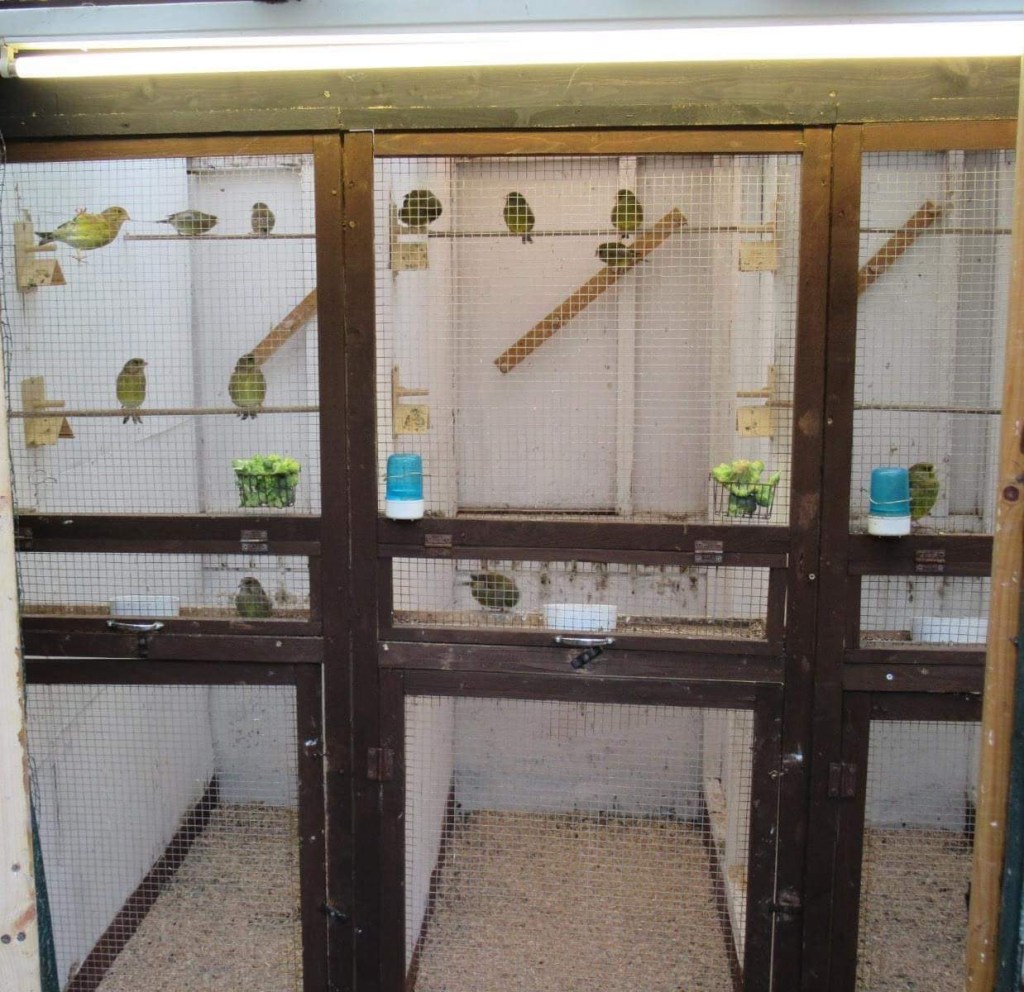
The first thing to address would be the housing for the birds, here I breed in aviaries, these are roughly 6ft in depth and 6ft high by 2.5ft wide, one breeding pair kept in each aviary , I also have several flight cages 3.5 ft long x 2ft x 2ft these are ideal for using one cock over a number of hens but pairs will also breed in these cages. Throughout the winter the birds are kept in same sex aviaries apart from the birds that will be exhibited which are in cages. Keep a close eye on the cock birds any overly aggressive birds will need to be separated although you can expect some squabbling to go on, it is also a good idea if you have a number of birds to keep young cocks in a different aviary to the older birds and never leave only two birds together.
My birds are fed greenfinch mix but approaching the breeding season it is advisable to weaken the mix with canary seed or try not to overfeed if you are keeping them on the greenfinch mix this is because too much sunflower and safflower could cause the birds to put weight on possibly leading to poor breeding results. If you have time it is also better to feed a small amount twice a day rather than one larger feed. At this time of year along with a little egg food I will add a few pinkies twice a week although the pinkies will be stopped once I know they are eating them, they are only used again for the first ten days after the chicks hatch, greenfinch will rear well without them on just egg food, soak seed, peas and sweetcorn but its something I have always done.
Once soak seed is started in the breeding season it will be continued until the birds finish the moult, if you don’t have time to chit the soak seed properly boiling the seed for ten minutes or so will still give you good results, Broccoli is given regularly I also make sure they have grit and cuttlefish. Pairing the birds here takes place early April although some breeders pair a little earlier. Prior to pairing all the birds nails will be checked and cut if needed and any excess feather around the vent will be trimmed on heavy feathered birds.
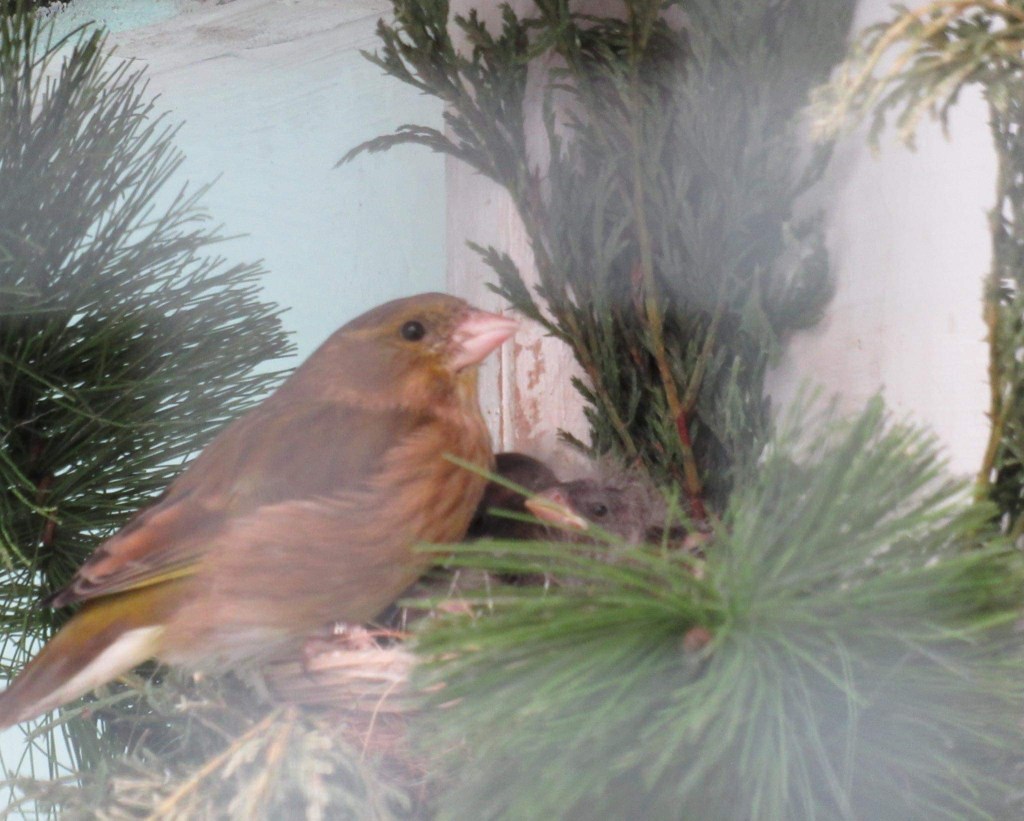
When preparing the aviaries for breeding I make two nest sites using coco fibre type nest baskets with some conifer or Christmas tree added this helps to make the hen feel safe as she incubates her eggs, the nest sites are placed at around four to five feet high, I never remove the eggs because the hen will normally only start to sit tightly after laying the third or fourth egg, hopefully if things go well fourteen days later the eggs will hatch but make sure egg food is there a couple of days before this in case the eggs hatch early. If the cock behaves himself he can be left with the hen but if he starts to misbehave remove him as the hen if quite capable of rearing on her own, by misbehaving I mean he could drive the hen from the nest and break eggs. Any youngsters are rung at 5 days with E rings available from the BBC or IOA, I always have a quick look the following day to make sure the rings are still on, you might also have to ring young that chipped later.
At around fourteen to sixteen days old the young will leave the nest, most hens are fine and carry on feeding the young but some hens especially younger ones may start pecking the young because they are now moving around and she is unsure what to do, give her a bit of time and she should settle and start feeding the young, if not the best thing to do here is catch her and the young putting them in a double breeder, this usually works and the hen carries on feeding the young. At 25 days old they are ready to be removed and put into flight cages, if you are unsure wait until you see the young eating by them selves. Once in the flight cages they will be treated with baycox for two days and this will be repeated a week later and then two days each month this is because young greenfinch are very prone to going light which is mostly but not always caused by coccidiosis. Never put young greenfinch in large groups as with any outbreak of disease you could quickly loose a lot of them, mine are put in groups of no more than six birds. I use very little medication other than baycox or similar when weaning the young because this is a stressful time for them,
If one bird shows any signs of respiratory disease it is best moved away from the others and treated with doxycycline however if you get two or three showing signs it is a good idea to treat all of the birds
As the young complete the moult if you decide you want to show your birds this is the time to start training them, at first they are put in show cages for no more than a few minutes gradually leaving them in longer, some birds will take more training than others and some will never make show birds, never keep birds that will not settle try to breed from birds with a good temperament, At this point the birds are kept in cages on their own, the idea is to put a little weight on them but not too much as this would cause them to loose condition so if they are underweight we can add more seeds like safflower and sunflower hearts but if they are over weight less of this is fed and they are given less seed,
it is important to give your birds plenty of baths causing them to preen and keep their feathers in top condition, Also spraying the birds with warm water a couple of days before a show will help them to look their best.
It takes time to build a stud of birds so look at it has a long term project trying to improve each year. Even if you decide showing is not for you please go and visit so you can see what good quality greenfinch look like because you should always aim to breed good birds even if you do not show and you will need to know what good looks like.
Good birds need to have a broad head that is in proportion to the body, birds having a small head on a big body will not do well on the show bench, Although show birds are generally of a good size its no good aiming for this and loosing feather quality and colour, the days of very large grey looking birds have long gone, a good bird will also need a slight rise on its back and also have good wing carriage so they are not hanging or equally not too high off the body,
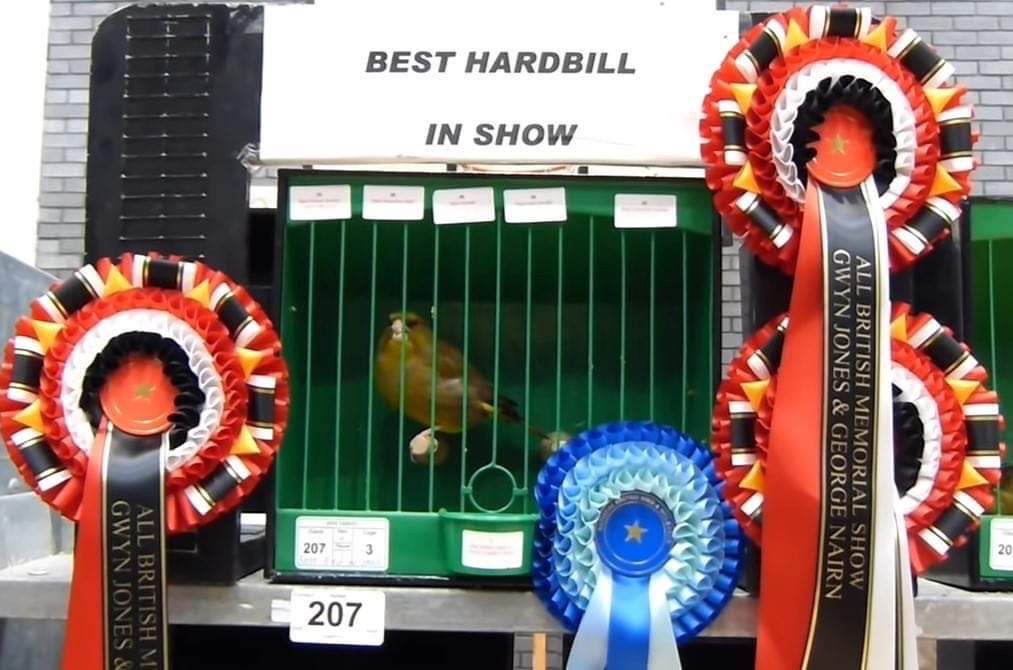
If you like competition then the greenfinch is ideal because the classes are normally big at native bird shows and we have some great greenfinch breeders in the UK. Don’t get disheartened if you don’t do well at first hopefully success will come as you improve.
Winning a show with a greenfinch you have bred yourself is a great achievement and I wish you the best of luck in your efforts to breed such a bird.
Kevin Taylor.
The London Fancy By Andy Early
I have talked many times about some of the distinguishing features of the birds.
I have tried to do this with photographs, since this is far better than trying to explain it by description, and readers can see for themselves rather than taking my word for it!
Historically, the London fancy was recognised as a canary that had a clear yellow body and dark wings and tail. The origins of the breed are unknown. It is referred to in the 19th-century texts, but fell into decline by the end of the 19th century and died out some time during the late 1930s. The modern London fancy was first developed by Piet Renders in Holland,
The London fancy is a bird of pattern like the Lizard canary. Generally, in the nest they are self birds, but moult out lighter in their first moult. This can vary from bird to bird, and they also sometimes get lighter in moults subsequent to the first. Some young London fancies will have light feathers on the head much like a Lizard canary. (See Pic 1.)

Just in case readers should think that every London fancy that is produced is a good one, they can be in fact be a bit of a mixed bag. Some of the youngsters show variegation in the nest, and when some of the self birds moult out, they will be self greens. Piet Renders reckons that these birds can be used to produce London fancies but, just as when breeding other sorts of canary, the better birds will be produced from the best birds. (See Pic 2.)

If we look at the pictorial and written standards for the bird, the obvious thing is that the head and body need to be as clear as possible. The perfect bird is a rarity, though there are some very good
examples with just the odd patch of melanin. (See Pics 3 a nd 4.) The majority of birds that are produced are what we refer to as “spangle-backs”. These are birds with areas of melanin on the body


(See Pics 5 and 6.) Those London fancy canaries that are close to the ideal are referred to as “classic” London fancies.
The next feature is the dark wings.
The next feature is the ground colour.
This is a feature in the modern London fancy that is fairly consistent, since the majority of birds will have dark tails and wings. However, there will be the odd bird that has light wing and tail feathers and as the birds age this will increase. (See Pic 7.)
In my view, one of the most difficult of the features to achieve is to get the greater covert feathers and the alula all the same colour. Almost invariably, there is a mix of dark and light feathers. (See Pics 8 and 9.)

whether the birds have a dark underflue, and the answer is yes they do. So for those buying London fancy stock, this is a good indication that birds
are from good lines of London fancies. I think that the dark underflue also gives the birds that deeper rich colour, particularly with the jonque birds.
However, as the birds age this will also disappear, with the result that a three- or four-year- old bird may have very little dark underflue. (See Pic 10.)

The feather quality and condition is a given with any exhibition bird. In my opinion, the most often overlooked features are the dark legs, nails and beak. When pairing birds, I try to balance pairings by taking these features into account. I like to see a full set of dark toenails, and the legs and beaks also as dark as possible.

 Down the Shed