Ringing Chicks
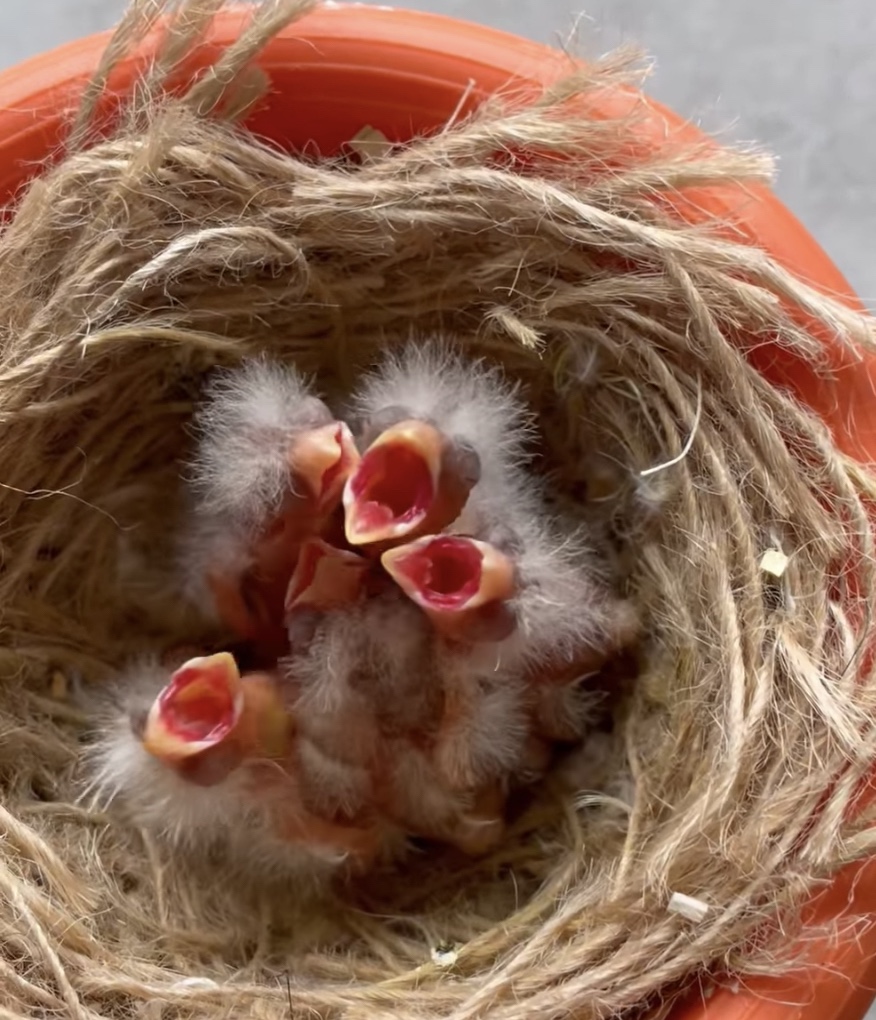
A tip on ringing your chicks; don’t presume all nests will be ready to ring on the same day. If you are closed ringing birds all nests, growth rates and level of feeding by parent (s) is different from nest to nest, so don’t leave it too late! Russell Sykes
Chicks falling behind in the nest
Very small chick’s are stimulated to beg for food by vibration or movement on the nest, so making sure the nest has the ability to vibrate or judder very slightly, will help chick’s to beg, encouraging the hen to feed. The more she feeds, the stronger the chick’s become, the more they beg, the more she feeds ect, ect. Andy Cooper
Weaning Youngsters
Preferably leave chicks with their parents until they are fully feathered, the specific length of their tails being a good indicator.
Removing them to early tends to set them back and cause issues if you need to return them to their parents.
I tend to seperate them using a wire slide once the hen needs to incubate the 2nd round eggs.
Replace the wire slide with a solid divider leaving a tiny gap for the cock to feed the youngsters.
Within a few days the cock will loose interest. Remove the chicks away to the far end of the shed or ideally as i do keep them in an “over flow” shed, out of sight out of mind!!
Never place perches or utensils in their weaning cages.
Put newspaper or similar on the floor which you can replace several times a day. Scatter seed (maw/chia/pellets) and your egg food mix on the floor. Leave them be for a few days until they stop crying to be fed and can be seen cracking seed.
Provide a luke warm bath and place sawdust or similar in their cages, removing the newspaper.
Place food in utensils and provide a perch down low.
Hook a show cage on the front to start early training.
Each to his own however this has proved 90% effective for me. Some chicks wont make it for different reasons dont be discouraged!!
Best of luck, norman ap huw. North Wales
Sexing young canaries
Here are some tips on determing sex of your chick
1.) From the time the chicks are three days old a vein on each side of the belly traveling down towards the vent and coming to a vee just in front of the vent can be seen on the young male. This vain cannot be seen on the female. Even though this vein exists throughout the life of the male, it is best to observe it prior to the bird becoming feathered.
2.) At five to eight days put all the chicks from the same nest on a towel and line them up like horses at a starting gate. The ones that can jump the farthest will be the males.
3.) While ringing the birds you will notice that some of them have a long center toe while others have three toes that are more nearly the same length. The ones with the long center toe will be harder to Ring and will be the male. The females are easier to Ring because the three toes are of nearly equal length.
4.) While ringing the chick look at the back bone. Along the side of the back bone the little male will have stiffer and deeper in color quills. The female seems to have only little fuzzy down long the backbone. Indicate the males on your nesting card.
5.) Before the chicks are feathered look down into the nest at the heads of the chicks. The ones with the more flat looking heads will be the males. The females have a more rounded crown.
6.) About the sixth or seventh day the chicks begin to open their eyes and from this time on into adulthood the eye of the male will be directly even with the beak. The eye of the female is placed above the beak causing a rounder appearing head.
7.) While the chicks are being fed by the parent in the nest observe the attitude of the chicks. The ones that stand the tallest, scream the loudest and demand to be fed first are the males. The female with her shorter legs does not stand as tall and is smaller because she is being fed less.
8.) Twenty-eight to thirty days some of the young males can be see swelling their throats and practicing to become good singers. (Because he tries to sing early does not mean that he will be your best singer. It just means that he is trying to sing early.)
9.) About 5 months of age give or take two weeks, the males are most generally the brightest and deepest in color; though some of my hens are as brightly colored. In the mottled the spots will be sharper and deeper in the males especially near the head. The center of the head in the yellow females will be very light.
10.) You may still have some females among the males even though they are about six months old. The female will sit lower on the perch because of the difference in her structure. She will also be causing trouble by fighting the young male as he tries to practice his song. She is not in breeding condition and wants no part of the nonsense which she thinks his song means.
Should all of the above methods fail, there is still one last sure way of sexing. In the event the bird lays an egg, it is for sure a female.
Lighting ! Go Natural or not
● Choice for natural daylight or electric light system
Nature is beautiful and by making use of the free natural daylight we can save some money and take no risks of the technical problems which can go with the use of artificial light systems. On the other hand we can use artificial light systems if we must breed our birds in a situation where we have not enough natural daylight to help our birds to get into the right breeding condition.
● Combination of both of them
Of course there is always the possibility to use both systems the same time, but it may always be best to keep things as easy as possible in order to avoid any problems.
● Bioritm is based on the amount of light during the seasons
If we give extra light hours to breed earlier, we must also darken the birdroom afterwards by closing down the licht system to change the biorytm to let the birds moult earlier in the year. It is very important for both males and females to come both into the same biorytm all year round and the same biorytm year after year again.
● Practical light schedule, based on the light system and bioritm
Depending on what country in the world you live , they have their own basic bioritm which is influenced by the distance to the equator, the times of the year and the climate conditions. To bring and keep the birds into their optimal biorytm we have to follow a practical light schedule. If we make use of the natural daylight system, we can make use of the natural biorytm. If we use an artificial (electric) light system we have to work this out in a technical light schedule on paper.
● Birds catch light in their eyes which influences the hypophysis
Right behind the eyes of a bird there is the hypophysis situated in the head and it works about the same way as a diafragma of a photo camera, catching the intensity and the duration of light hours
during the years.
● The hypophysis provides different enzymes for breeding or moulting
More light means coming into breeding condition, instead of moulting
Less light means getting into moult, instead of breeding
Canaries need at least 12,5 light hours to be fertile after a rest period of at least 9 month
Humidity
•Canaries are originally from the sub tropics and live in rather dry areas,
•Eggs need at least a humidity of around 50 or 60% to hatch and can dry out, which makes the eggshell impossible for a chick to open
•Problems occur because of to much or not enough humidity
•Harmful bacteries develope frequently under damp conditions
•A perfect humidity maintenance keeps the birds in good health without a need for using medicines ,if it feels damp to you! its also damp for the birds
•Medicines being used in the wrong way can make birds ill or even kill them
•Fresh and clean drinking water should be always be available at any time
•The ideal birdroom humidity is around 50%
Ventilation
● There are 2 ways of ventilation
● Natural way caused by wind blowing through the bird room buy opening the doors and windows
● Mechanical way caused by an electrical/mechanical ventilation system that sucks the air out of the birdroom
● Ventilation is very important to bring fresh and clean air in your birdroom
● A good ventilation helps you to keep the birdroom fresh and also helps with the regulation of the temp oin the birdroom and in gereral the summer months can either very hot or very cold
● Important is to ventilate across the bottom of the birdroom because Stale air sinks down to the bottom so the addition of a few vents lower down in the birdroom will assist in the movement of air around the birdroom

 Down the Shed